Understanding Darkore: The Anatomy of a Gothic Display Typeface
In the vast landscape of typography, display fonts serve a singular, critical purpose: to arrest the viewer's gaze and convey a specific mood within seconds. While sans-serifs and serifs handle the heavy lifting of readability, display typefaces act as the visual shorthand for emotion. Darkore stands as a prime example of this phenomenon, representing a bold, gothic style that pushes the boundaries of conventional design. It is not merely a collection of letters; it is a thematic tool engineered to evoke a sense of dread, power, and theatricality. For designers looking to bridge the gap between legibility and atmosphere, understanding the construction and utility of a font like Darkore is essential for mastering the art of visual storytelling.
The Visual Language of Gothic Typography
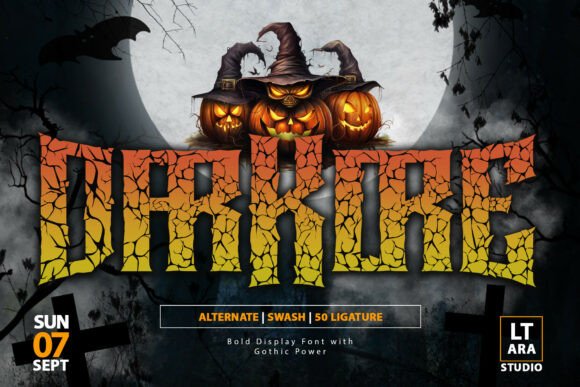
To appreciate the impact of Darkore, one must first understand the historical and aesthetic roots of gothic display fonts. Often associated with medieval manuscripts, heavy metal album art, and horror cinema, this genre of typography relies on specific structural traits to create its signature look. These traits include high contrast between thick and thin strokes, sharp angular edges, and a sense of verticality. Darkore modernizes these archaic forms by integrating a cracked texture directly into the letterforms. This textural element transforms the font from a static symbol into something that appears organic and decayed, as if the letters themselves have survived a centuries-old haunting.
The "eerie atmosphere" mentioned in its description is achieved through deliberate manipulation of negative space. In typography, the white space inside and around letters is just as important as the black ink. Darkore utilizes tight kerning and dramatic ligatures to create a dense, imposing block of text. This density mimics the visual weight of stone or iron, materials often associated with gothic architecture and heavy machinery. When a viewer sees Darkore, they subconsciously process these visual cues, immediately associating the text with concepts of strength, darkness, and intensity.
Anatomy of Fear: Deconstructing the Features
What separates a standard horror font from a professional design asset is the depth of its features. A basic font offers a single set of characters, whereas a sophisticated typeface like Darkore offers a complex toolkit for customization. The inclusion of alternates, swashes, and ligatures is crucial for designers who need to avoid the "cookie-cutter" look of default typography.
- Alternates and Swashes: These allow designers to swap out standard letters for more decorative versions. For a word like "DARKORE," using swashes on the "D" and "E" can create unique silhouettes that prevent the text from looking repetitive. This is particularly useful for logos where every letter needs to contribute to a unified, custom emblem.
- Ligatures: These are specific pairings of letters that merge into a single glyph. In a font with sharp edges like Darkore, ligatures prevent awkward collisions between characters, ensuring that the "fearless statement" remains legible and aesthetically pleasing rather than cluttered.
- Multilingual Support: Professional usage requires global compatibility. A font that cannot handle accented characters limits its marketability. Darkore’s support for multiple languages ensures that its gothic power can be applied to international campaigns, from horror film festivals in Europe to metal bands touring in South America.
Strategic Applications in Modern Design
While the obvious application for a font like Darkore is within the horror genre, its utility extends to various sectors that rely on high-impact visuals. The key to using such a distinct typeface is context. It functions best where brevity and impact are prioritized over long-form readability.
Event Branding and Poster Design
Halloween events, haunted houses, and escape rooms rely heavily on immediate atmospheric signaling. A poster for a haunted attraction must convey the theme—be it zombies, ghosts, or psychological thriller—in a split second. Darkore’s cracked texture and sharp edges immediately signal "danger" or "fear." It commands attention on a crowded flyer or a digital ad banner, cutting through the visual noise of standard sans-serif typography.
Music and Merchandise
The heavy metal and rock genres have a long-standing relationship with gothic typography. However, band logos must be versatile enough to work on album covers, t-shirts, and stage backdrops. The "bold display" nature of Darkore ensures that it remains legible even when printed on textured fabrics or viewed from a distance on a stage. The "cracked" aesthetic resonates with the raw, distorted soundscapes of these musical genres, creating a cohesive brand identity.
Gaming and Digital Media
In the world of video games, UI/UX designers often use gothic fonts for title screens, level headers, or inventory menus in fantasy or horror settings. Darkore’s "eerie atmosphere" helps immerse the player in the game world before they even press start. Because it includes alternates, game designers can customize the typography to match specific in-game factions or lore, adding a layer of depth to the user experience.
Technical Considerations for Implementation
Deploying a display font like Darkore requires more than just installation; it requires technical awareness to ensure the design renders correctly across different mediums. The very features that make it striking—its sharp edges and textures—can pose challenges in certain environments.
- Resolution and Scalability: Textured fonts often rely on high-resolution rendering to display their details. When using Darkore for web design, it is vital to use high-quality web font formats (like WOFF2) and ensure that the server delivers the font efficiently. On low-resolution screens, the "cracked" details might blur, turning the texture into visual noise. Therefore, testing across devices is a necessary step in the workflow.
- Color and Contrast: A font with this much visual weight demands high contrast. Placing Darkore on a busy, detailed background can make the text illegible. It is most effective when placed against solid, dark backgrounds or used as an overlay on images with a gradient darkening effect. The "gothic power" of the font is best realized when the letters have room to breathe.
- File Management: Because Darkore comes packed with extensive features (swashes, ligatures, alternates), the font file size may be larger than standard fonts. Web developers should consider subsetting the font—removing unused characters or language sets—to optimize load times without sacrificing the necessary design elements.
Beyond the Surface: The Psychology of Fear in Design
Why do we gravitate toward designs that utilize "darkness and style"? The psychology behind the effectiveness of fonts like Darkore lies in the concept of benign masochism—the enjoyment of negative sensations in a safe environment. Consumers of horror media, extreme sports branding, or gothic fashion are engaging in a controlled thrill. The typography acts as a gatekeeper to that experience.
When a business owner or creator chooses Darkore for their project, they are making a calculated decision to tap into these primal emotions. They are signaling that their content is not for the faint of heart. This creates an immediate filter, attracting an audience that is specifically looking for that intensity. In a market saturated with friendly, rounded, and soft typography, the sharp, "cracked" severity of Darkore is a disruption. It forces the viewer to pay attention because it feels different, dangerous, and authoritative.
Workflow Integration for Creators
For the hobbyist or the seasoned graphic designer, integrating a specialized font into the workflow involves experimentation. The "full creative control" offered by Darkore suggests that the font is not a static image but a dynamic tool. Designers should explore the character map to discover hidden glyphs that might perfectly fit a specific project need.
For instance, when designing a logo, a designer might combine a standard letter with a swash alternate to create a custom ligature effect that is unique to that brand. This level of customization ensures that the final product does not look like a template. It transforms the design process from simply "typing" to "sculpting" with letters. The "fearless statement" is not just made by the words chosen, but by how the typography shapes those words into visual art.
Ultimately, Darkore represents the intersection of technical font engineering and thematic storytelling. It is a tool designed for those who need to command attention and evoke a specific, visceral reaction. Whether used for a movie poster, a metal band logo, or a Halloween invitation, its value lies in its ability to turn standard text into a "haunting work of art." By understanding its structure, applications, and technical requirements, creators can harness its gothic power to elevate their designs from mundane to menacing.