A Practical Guide to Evaluating the Cursive Handwriting Alphabet Tracing Set
When it comes to selecting educational resources for children, the sheer volume of options can be overwhelming. For parents and educators focusing on penmanship, the Cursive Handwriting Alphabet Tracing Set represents a specific category of tools designed to bridge the gap between print literacy and connected writing. Unlike general coloring pages or standard worksheets, this set is tailored to the unique demands of cursive formation. It serves as a foundational resource for those looking to introduce the flow and rhythm of connected letters without the immediate pressure of freehand composition.
Understanding the utility of this set requires looking beyond the simple definition of "tracing." It is a specialized instrument intended to build muscle memory, improve fine motor control, and facilitate letter recognition. For adults evaluating this resource, it is helpful to view it not just as a printable asset, but as a methodological approach to handwriting instruction that prioritizes structure and repetition.
Deconstructing the Tracing Font and Design
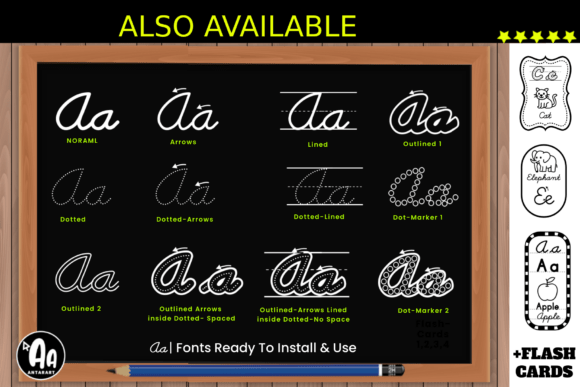
The core component of the Cursive Handwriting Alphabet Tracing Set is the font design itself. In the world of handwriting instruction, not all cursive fonts are created equal. Some fonts prioritize aesthetic flourish, while others prioritize legibility and ease of formation. This particular set typically utilizes a font style that balances visual appeal with educational functionality. The letterforms are usually designed with continuous strokes, minimizing the need for lifting the pen, which is essential for developing a natural writing flow.
When comparing this font style to others available in educational markets, one often finds a spectrum ranging from "decorative cursive" to "educational cursive." Decorative fonts, often found in scrapbooking or graphic design, can be confusing for young learners due to excessive loops or non-standard connections. The Cursive Handwriting Alphabet Tracing Set generally adheres to standard educational cursive models (such as D'Nealian or Zaner-Bloser inspired styles), ensuring that the skills learned are transferable to standard classroom expectations.
Visual Cues and Stroke Guidance
A distinct feature of high-quality tracing sets is the inclusion of directional cues. While some basic tracing worksheets simply provide a dotted line to follow, advanced versions of the Cursive Handwriting Alphabet Tracing Set often include numbered starting points or directional arrows. This subtle difference is a major decision factor for educators. Without these cues, students may develop poor habits, such as starting letters from the bottom or reversing the natural flow of the script.
Furthermore, the visual weight of the tracing lines matters. If the font is too thin, it can be difficult for developing eyes and hands to track. If it is too bold, it obscures the student's own writing. The design philosophy behind this set typically aims for a balanced opacity that allows the guide to be visible while the student's ink is on the page.
Comparing Educational Approaches: Tracing vs. Freehand
When parents or teachers search for handwriting resources, they often encounter two opposing philosophies: the "tracing-first" method and the "freehand-exposure" method. The Cursive Handwriting Alphabet Tracing Set firmly falls into the former category, but it is important to understand the tradeoffs.
The tracing-first method is highly effective for building confidence and spatial awareness. It reduces the cognitive load on the child; instead of worrying about how to form the letter, they focus on the movement. This is particularly beneficial for children with dysgraphia or fine motor delays, as the path is pre-determined. However, a potential limitation of over-reliance on tracing is "dependency," where a child struggles to transition to blank lines because they are accustomed to the visual guide.
Conversely, freehand exposure encourages independent motor planning from the start but can lead to frustration and illegibility if the child lacks the motor skills to execute the shapes. The Cursive Handwriting Alphabet Tracing Set serves as a bridge. It is not intended to be the only method of instruction, but rather the first step in a scaffolded learning process. It provides the safety net required to master the basic shapes before removing the support.
Practical Applications for Teachers and Homeschoolers
The versatility of the Cursive Handwriting Alphabet Tracing Set lies in its adaptability to different learning environments. For classroom teachers, the resource is often used to create "alphabet centers"—rotational stations where students practice specific skills independently. Because the set is typically designed for printing, it allows for high-volume usage, which is a practical necessity in a classroom of 20+ students.
For homeschoolers, the value proposition is slightly different. Homeschool curricula often require flexibility. A parent might use the tracing set to create DIY tracing books, binding several pages together to create a personalized workbook tailored to the child's pace. This is often more cost-effective than purchasing pre-printed workbooks, especially when teaching multiple children over several years.
Therapeutic and Special Needs Contexts
It is worth noting that the Cursive Handwriting Alphabet Tracing Set has applications beyond standard education. Occupational therapists frequently utilize tracing exercises to improve fine motor skills, hand-eye coordination, and muscle strength. In these contexts, the specific style of the font may be less important than the act of following a continuous line.
However, for therapeutic use, the "fit" of the resource is critical. Some tracing sets use complex loops that may be too challenging for children with significant motor delays. In such cases, a simplified version of the tracing set, or a resource with larger bounding areas, might be a better alternative. The decision to use this specific set should be based on the child's current ability level rather than their age.
Strengths, Limitations, and Decision Factors
To make an informed decision, it is helpful to weigh the specific strengths and potential drawbacks of the Cursive Handwriting Alphabet Tracing Set against your specific needs.
Key Strengths
- Consistency: The set provides a uniform standard for letter formation, ensuring that students learn a cohesive alphabet rather than a mix of styles.
- Repetition Mastery: Tracing allows for high-volume practice without the fatigue associated with freehand writing, as the mental effort is lower.
- Early Introduction: It enables the introduction of cursive concepts before a child has fully mastered print, allowing for a blended learning approach.
Potential Limitations
- Transition Gap: As mentioned, students may struggle to move from the guided lines of the tracing set to independent writing on lined paper.
- Pacing Issues: Standard tracing sets move at a fixed pace (A to Z), which may not align with a curriculum that introduces letters by frequency of use or complexity of shape (e.g., learning 'c' and 'l' before 'f').
When to Choose This Resource (and When to Look Elsewhere)
The Cursive Handwriting Alphabet Tracing Set is likely the right choice if your primary goal is to introduce the mechanics of cursive writing. It is ideal for beginners who need to understand how letters connect and where strokes begin and end. It is also a strong option for creating supplementary materials, such as morning work packets or homework reinforcement sheets.
However, you may need a different option if:
- You need contextual learning: If the child needs to learn cursive within the context of words and sentences immediately, a tracing set focused on isolated letters might feel disjointed. In this case, a resource that traces full words or sentences would be more appropriate.
- The child is resistant to repetition: Some children find tracing tedious. If engagement is a major hurdle, a gamified app or a dry-erase board with guided lines might offer better motivation than a static printable set.
- You require advanced stylistic instruction: If the goal is calligraphy or artistic lettering, standard educational tracing sets are too rigid. Artistic brush-pen tutorials or calligraphy-specific guides would be better suited.
Integrating the Set into a Broader Curriculum
The most effective way to use the Cursive Handwriting Alphabet Tracing Set is to treat it as one tool in a larger toolkit. For instance, a balanced approach might involve:
- Step 1: Use the tracing set to introduce a new letter, focusing on stroke order.
- Step 2: Transition to "rainbow writing," where the child traces the letter in multiple colors over a guide.
- Step 3: Move to a whiteboard where the child writes the letter freehand next to a model.
- Step 4: Finally, apply the letter in a writing exercise on standard lined paper.
By using the tracing set within this progression, you mitigate the risk of dependency while maximizing the benefits of muscle memory development. The goal is not just to complete the worksheet, but to internalize the motion so deeply that it becomes automatic.
Ultimately, the decision to utilize a Cursive Handwriting Alphabet Tracing Set comes down to your educational philosophy and the learner's specific needs. It offers a low-stakes, high-repetition environment for mastering a complex skill. While it does not replace the need for guided instruction or freehand practice, it provides a structured, accessible, and practical foundation for anyone looking to improve their penmanship or teach the art of cursive writing. By understanding its distinct features and appropriate use cases, you can ensure it serves as a helpful stepping stone rather than a crutch.